Redesigning the
 Send Bulk Email
feature for better visibility and control
Role
Product Designer
[feature design]
Duration
3 days
Tools
Figma
About Temelio (Client)
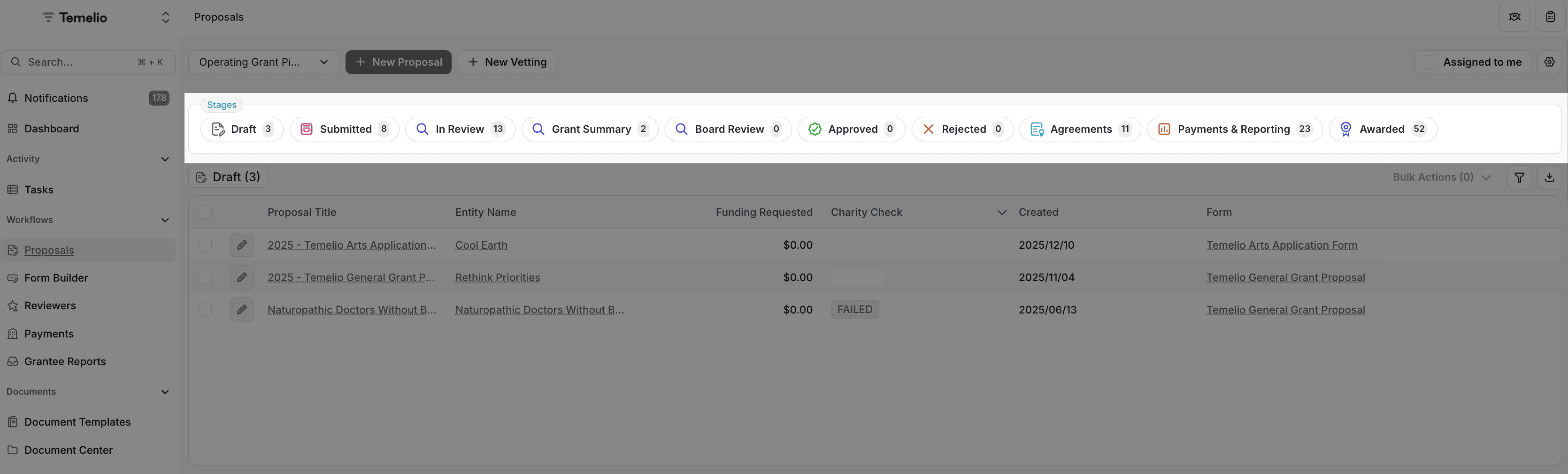
Temelio is a grants management platform built for foundations to manage their entire funding lifecycle. From applications and reviews to disbursements and impact tracking.
Problem
Temelio helps teams manage grant submissions across stages, where each stage change triggers an email to applicants. These actions are high-impact and irreversible, making every update a critical decision. Limited visibility and control made this process feel risky, reducing confidence at the point of action.
Current Modal Assessment
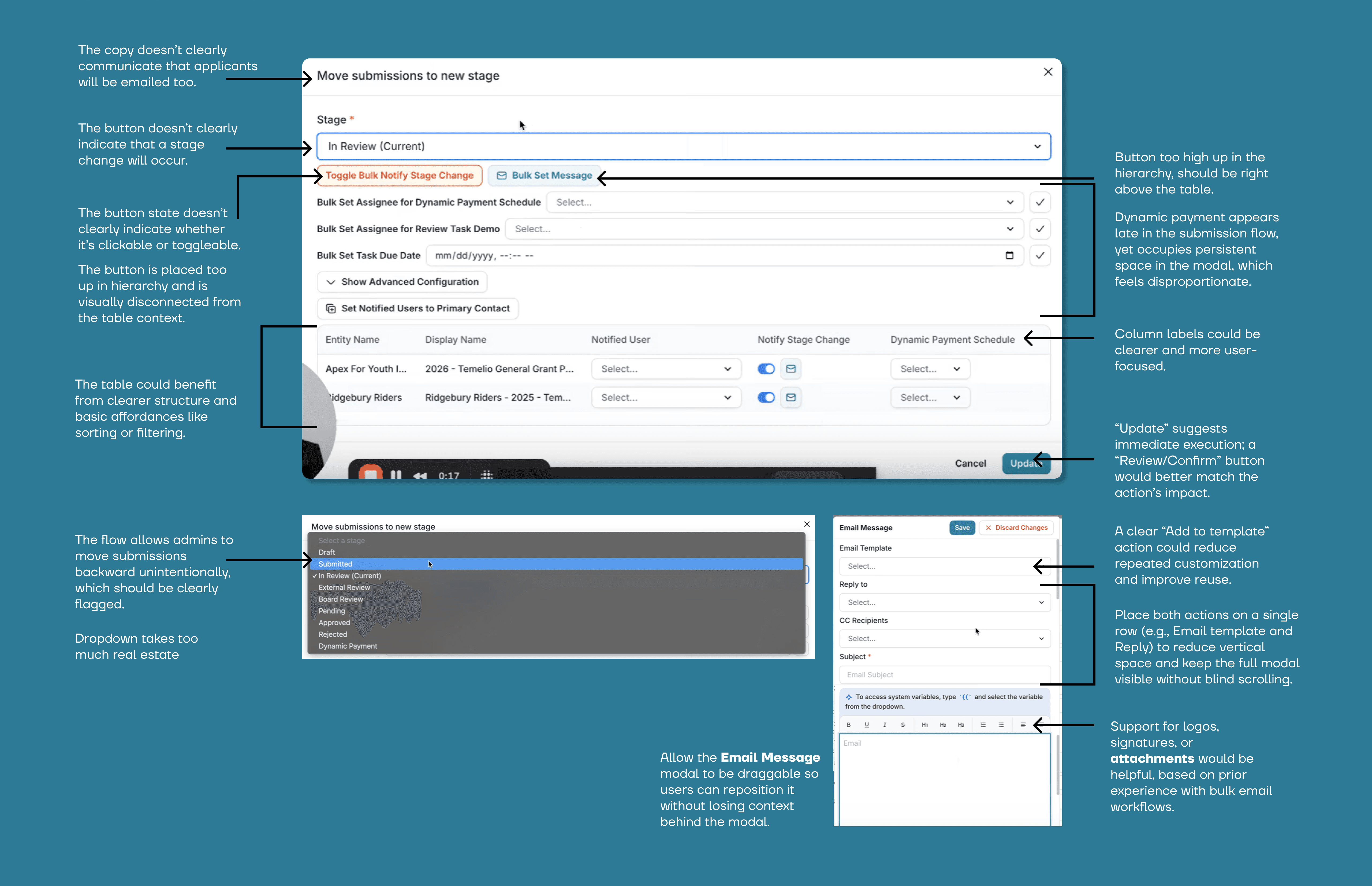
With the key user problems identified, it was critical to audit the existing modal to uncover how its structure, copy, and interactions were driving these issues. I evaluated the modal through the lens of clarity, usability, and decision-making at critical moments.
Derived Insights + Redesign Foundations
Simplify Copy
Replaced technical, system-heavy language with clear, action-focused UX copy.
Reduce Modal Complexity
Removed nested modals and restructured content to maintain context and reduce scrolling.
Improve Table Usability
Introduced sorting, filtering, and clear selection states for better scanning and control at scale.
Clear Content Structure
Organized the flow into distinct sections — stage change, email configuration (bulk/custom), and scheduling.
Future Phasing:
Step-Based Tracker
Proposed a dedicated flow to separate review, messaging, and status for better clarity in high-impact actions.
Future Phasing: Omnichannel Clarity
Standardized “email” terminology and outlined scope for multi-channel notifications like SMS.
 Bulk Set Message
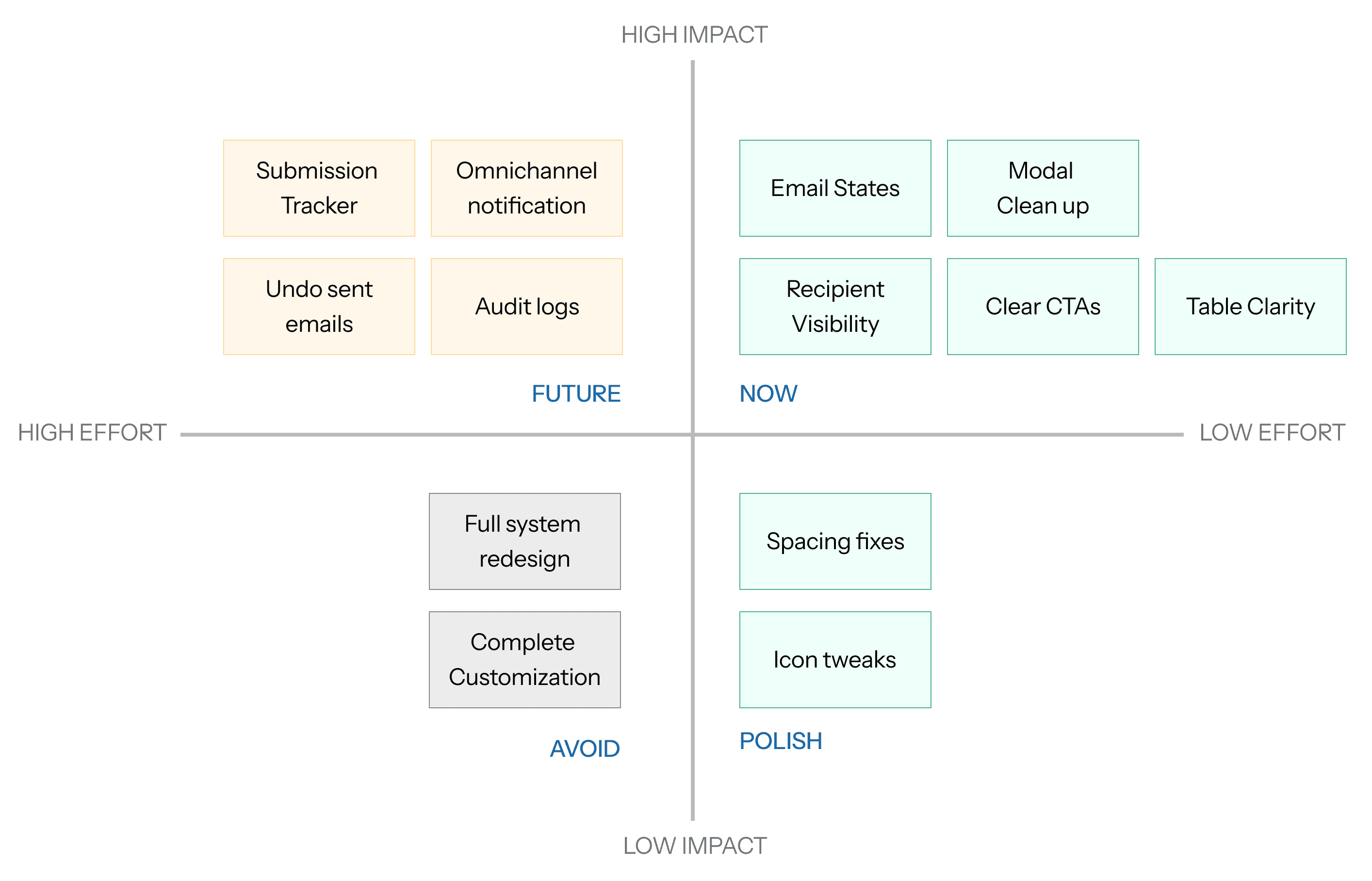
Prioritization and Decision Matrix
Given the irreversible nature of email actions, the focus was on reducing risk and improving clarity without slowing down bulk workflows. Improvements were prioritized based on impact vs effort, optimizing the existing modal for immediate gains, while deferring larger structural changes to future iterations.
The key trade-off was balancing speed vs safety, ensuring admins can act quickly while still having enough visibility and control to avoid irreversible errors.
Redesign
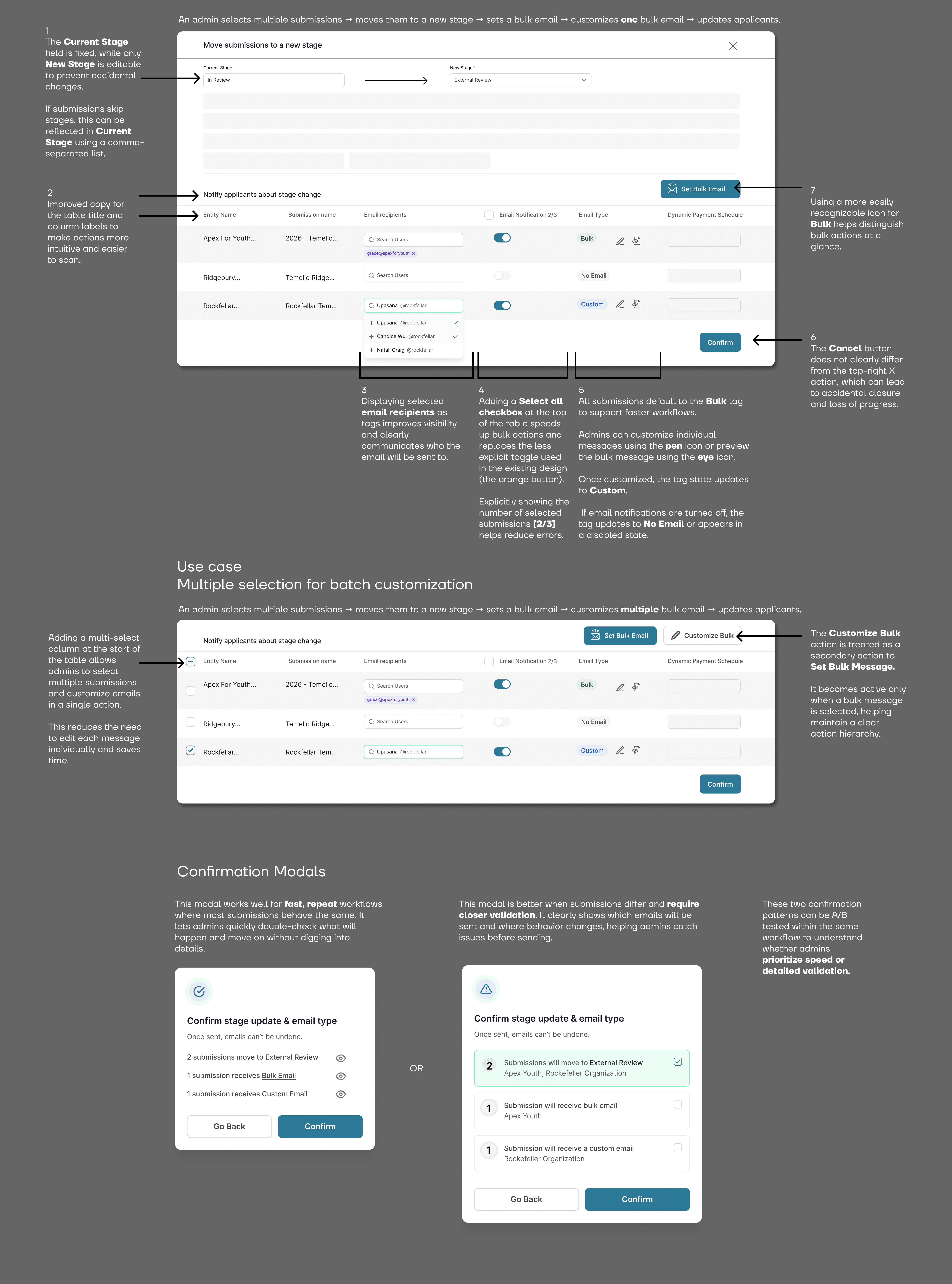
Designing within the constraints of the existing modal, I focused on improving the current experience without expanding scope. While a dedicated space for stage management would be ideal, that is planned as a separate tracker in a future phase.
Within the modal, I redesigned the section by introducing clearer affordances and feedback, so admins are more aware of the changes and their impact in real time.
Improvements
Clearer Mental Model
Structured the flow into steps reducing cognitive load and making impact visible.
Simplified Modal Experience
Removed nested modals and reorganized content into clear sections to maintain context and reduce scrolling.
Visible Email Impact
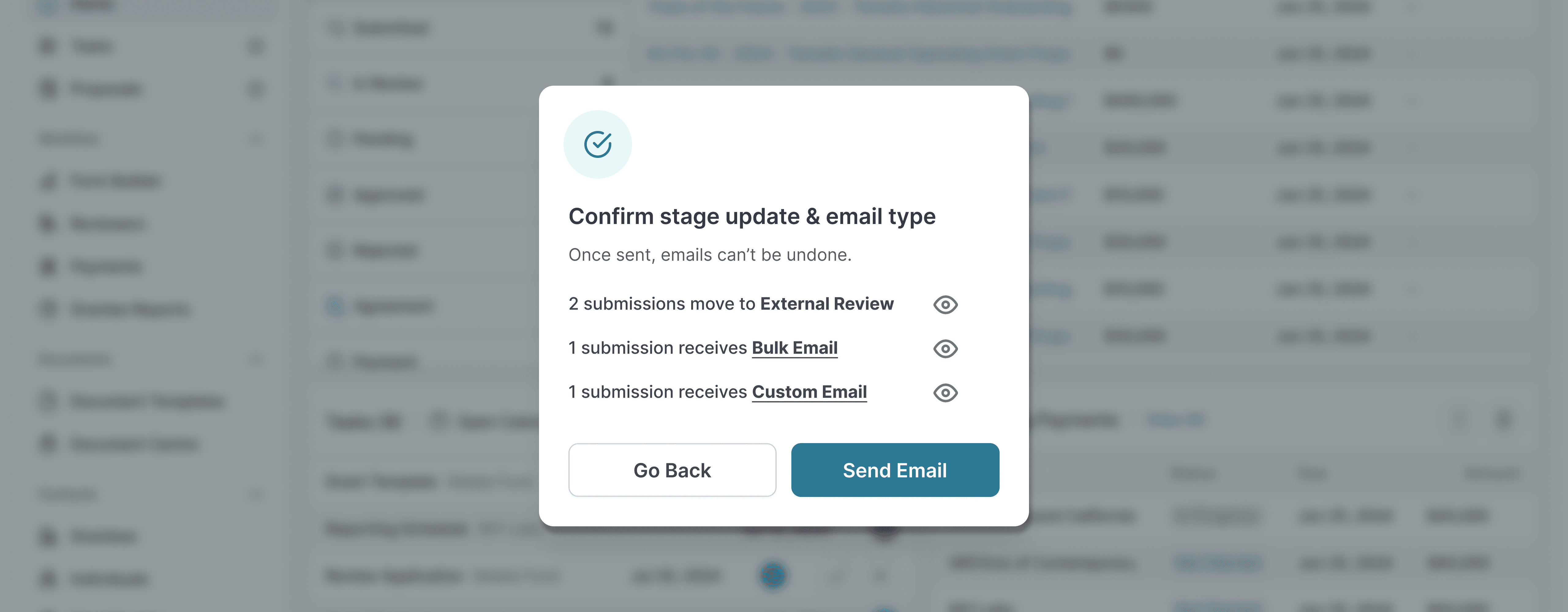
Made it explicit which submissions receive bulk, custom, or no emails, along with total selections while supporting edgecases.
Safer Confirmation
Added a final review step that summarizes recipients and highlights irreversible actions, building confidence before sending.
Outcome
The redesigned flow reduces anxiety around irreversible communication, makes email behavior predictable and visible, supports speed without sacrificing safety, and builds trust for admins managing large volumes.
Future Direction
Evolve this into a dedicated, step-based “Submission Tracker” that separates stage management, messaging, and status tracking more clearly. Explore omnichannel notifications (e.g., SMS) with explicit controls and visibility.
If bulk email actions continue within the modal, A/B testing can help determine the right level of confirmation and detail—whether users prefer more safeguards or a faster, lighter flow.
Learnings
Designing within constraints reinforced the need to prioritize clarity over completeness. Edge cases—like mixed email states and partial selections—shaped key decisions and made system behavior more explicit. Working within the modal meant balancing ideal solutions with practical improvements that reduce risk and build confidence.